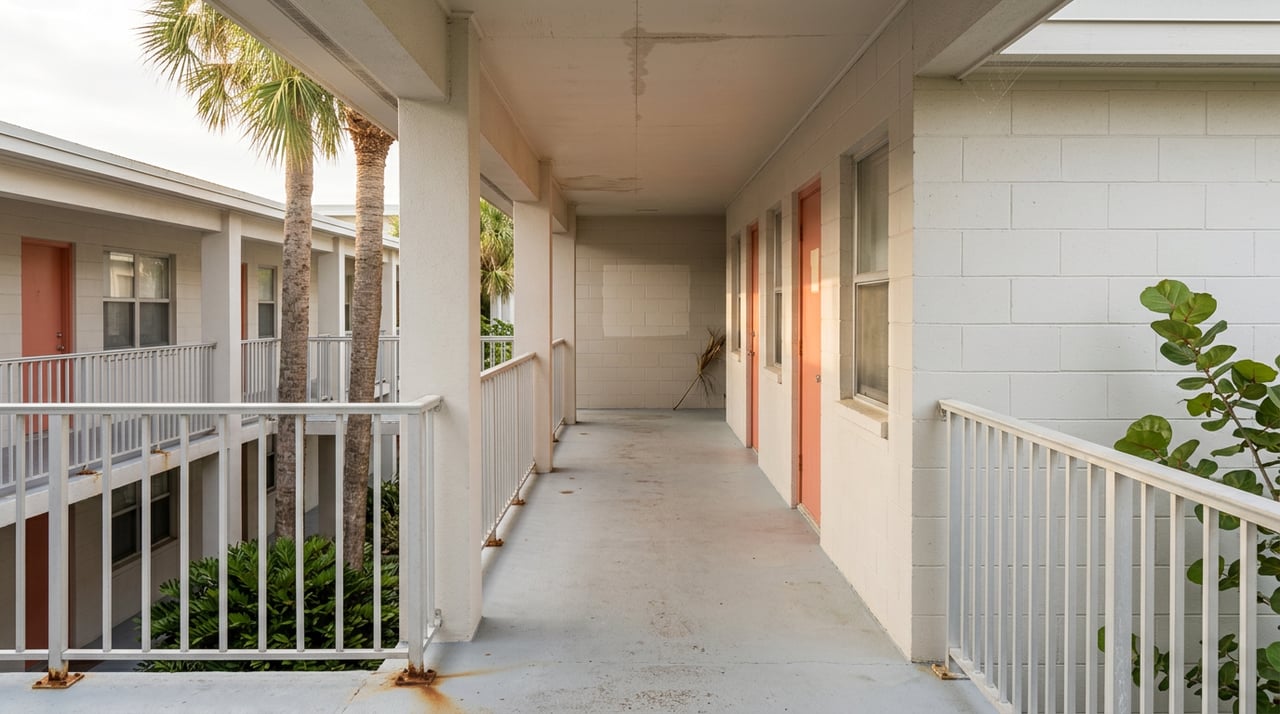
A 41-unit timeshare on Sarasea Circle sits at the center of a fight that tells you more about buying a Siesta Key condo than any median-price headline. If Sea Club V were destroyed by a hurricane tomorrow, Florida's disaster rebuild rules would let the owners replace all 41 units. If the association tore the building down voluntarily today, ahead of the next storm, current density rules would only allow 18 units to go back up.
That gap, 41 units versus 18, is not a hypothetical. It came up repeatedly in Sarasota County Commission meetings through 2025 as officials debated whether to let aging Siesta Key condo buildings demolish and rebuild proactively without losing density. The commission ultimately said no. As of the board's November 20, 2025 vote, the amendment that would have protected density for a voluntary rebuild was denied unanimously, with the commissioner who proposed it recused. The practical result for buyers and sellers on Siesta Key: a building's age, height, and construction year now do more to determine its financial risk than its view or its finish level.
The math behind one number
The reason a torn-down building loses units comes down to a federal rule that has nothing to do with local zoning ambition and everything to do with flood insurance math. FEMA's substantial improvement rule, often called the 50% rule, says that once repair or improvement costs reach half of a structure's market value, the entire building must be brought up to current flood-zone construction standards, not just the damaged portion. On Siesta Key, where Hurricane Milton made landfall, base flood elevation runs between 7 and 9 feet, so meeting that standard from scratch typically means elevating the whole structure or building new.
That rule cuts two ways depending on how the trigger gets pulled. A building destroyed by a hurricane gets to rebuild at its pre-storm density under Florida's disaster provisions. A building torn down voluntarily, before a storm forces the issue, falls under ordinary zoning and must meet the density limits adopted after 1986. For any Siesta Key condo built before that year, most of them, that means a smaller building goes back up in place of the old one.
What the county tried to change, and why it didn't
Sea Club V became the test case because its owners wanted to get ahead of the problem rather than wait for it to happen to them. County Commissioner Smith, an architect, made the underlying concern plain during a 2024 hearing, arguing that Siesta Key's pre-2000 condo stock could not withstand a major storm and that owners deserved a proactive path.
"Which means none of these condominiums, the 130, will withstand a hurricane disaster."
The number kept shifting in later reporting, sometimes cited as 130 buildings, sometimes 137, but the shape of the problem stayed the same: a large share of Siesta Key's condo inventory predates the density and construction standards the county would apply to a voluntary rebuild. Protect Siesta Key president Lourdes Ramirez opposed loosening the rules, pointing out an odd asymmetry: an owner who waits for a storm to destroy the building keeps full rebuild rights, while an owner who acts early to prevent that outcome gets punished with fewer units. Commissioners Ron Cutsinger and Joe Neunder both said publicly during those 2024 hearings that they were uncomfortable with the unintended consequences, and by the time the board took its final vote in November 2025, the whole comprehensive plan amendment was set aside.
The practical upshot for anyone shopping a pre-2000 building on the Key right now is that the incentive to fix problems ahead of a disaster is weaker than it should be, and the paperwork that reveals whether an association is heading toward a forced rebuild or a manageable repair is more important than the listing photos.
The paperwork that tells you which side of the line a building sits on
Florida's post-Surfside reforms give buyers a way to check this before writing an offer, if they know to ask. Senate Bill 4-D and its 2023 follow-up, Senate Bill 154, created two separate requirements for condo and co-op buildings three or more habitable stories tall: a milestone structural inspection and a Structural Integrity Reserve Study, known as a SIRS. House Bill 913, which took effect July 1, 2025, adjusted some of the deadlines but kept the core framework intact.
The milestone inspection is the physical check. It starts as a visual Phase 1 review and escalates to invasive Phase 2 testing if inspectors find substantial deterioration. Buildings generally face their first inspection at 30 years of age, though local conditions can move that trigger to 25 years for coastal buildings. Any building that turns 30 in 2026 is generally looking at a December 31, 2026 deadline to complete it, and buildings that need both the milestone report and the SIRS by that date can combine the two studies with one engineering firm.
The SIRS is the money document. It forces an association to price out major structural components, roof, load-bearing walls, waterproofing, electrical, plumbing, and set a funding schedule to pay for them. Associations that adopted their budget on or before December 31, 2024 had a narrow window to vote to underfund those reserves, but that option closed, and every affected building has been required to fund to the study's schedule since January 1, 2026. Boards can no longer quietly defer the math the way they could before Surfside.
Before writing an offer on a Siesta Key condo, request:
- The most recent milestone inspection report, and whether it flagged Phase 2 concerns
- The current SIRS and whether the association is funding to its schedule or still catching up
- 24 months of board meeting minutes, which often surface a pending assessment before it's formally voted
- The master insurance policy, specifically the wind and hurricane deductible language
- Confirmation of the building's certificate of occupancy date, since that single number determines when the next milestone cycle hits
Under House Bill 1021, associations with 25 or more units now have to post governing documents, budgets, and reserve studies for owners, which makes this diligence easier than it used to be. The Florida DBPR's condominium resource page lays out the statutory requirements in full if you want to check a building's timeline yourself.
What a real assessment looks like depending on where a building sits
The dollar range between a well-funded building and an underfunded one is not a rounding error. It's the difference between a manageable line item and a forced sale.
| Building profile | Typical special assessment | What's driving it |
|---|---|---|
| Built after 2000, reserves funded on schedule | $1,000 to $3,000 for routine capital projects | Association has been saving to the SIRS all along |
| Older building, adequate reserves, isolated project | $2,000 to $10,000 | Roof or concrete restoration budgeted in advance |
| Older building, underfunded reserves, post-SIRS discovery | $25,000 to $60,000, sometimes over $100,000 | Milestone inspection or SIRS surfaces deferred structural work, or owners split a hurricane deductible |
Two buildings that sold for similar prices before Milton and Helene made landfall in 2024 can end up on opposite ends of that table depending entirely on how their board handled reserves in the years before the storms, not on anything visible in a listing photo. At the Palm Bay Club, where 17 ground-floor units flooded, general manager France Langan described a permitting process that felt like it kept shifting the goalposts, while owners waited months for approvals. At Siesta Harbor, where Tom Surprise's ground-floor unit was one of 42 in the 168-unit complex left displaced, the longtime resident expected a six-month recovery and found it stretched well past that. Sarasota County has acknowledged that in the early months after the storms it rejected more than half of the permit applications it received, mostly over paperwork errors, before approval rates improved. None of that shows up in a price-per-square-foot comparison, and all of it shows up in the SIRS and the board minutes if you ask for them.
Reading today's numbers with this in mind
The island's headline numbers describe a buyer's market on the surface. Redfin put the median Siesta Key home sale price at $899,000 over the three months ending May 2026, down 12.6% from the same period a year earlier, with homes selling in about 50 days. Zillow's June 2026 figure for average home value came in lower still, at $825,673, down 5.4% year over year. Those numbers are real, but they average across a market where a post-2000 building with funded reserves and a pre-2000 building carrying assessment risk get folded into the same line. A buyer comparing two units at similar list prices is not comparing two similar assets until the milestone and SIRS documents say otherwise.
FAQ
Does the milestone inspection and SIRS requirement apply to single-family homes on Siesta Key? No. The requirement applies specifically to condominium and cooperative buildings three or more habitable stories tall. Single-family homes, villas, and townhomes in HOA communities fall outside this law entirely, though they still face the FEMA 50% rule if they sit in a flood zone and sustain damage.
If a building already completed its milestone inspection, is it automatically a safe purchase? Not on its own. A completed inspection tells you the building has been looked at, not that any problems it found have been paid for. If a Phase 2 inspection identified structural deterioration, the association has 365 days from the report to start repairs, and the real question for a buyer is whether the SIRS shows funding in place to cover that work without a special assessment.
Can a seller withhold information about a pending special assessment? Florida law and the newer transparency rules under House Bill 1021 require associations with 25 or more units to make governing documents, budgets, and reserve studies available, and a buyer's agent can request the full document package once a contract is signed. A pending or recently approved assessment is the kind of detail that surfaces in board minutes even before it appears in a formal disclosure.
Buying or selling a condo on Siesta Key right now means reading a building's paper trail as carefully as its floor plan. If you want a second set of eyes on a milestone report or a SIRS before you write an offer, or you're weighing whether now is the right time to list a unit given your building's reserve position, Colleen Finnegan has spent years working through exactly this kind of building-by-building diligence on the Key. Let's Connect.
